

Cloud infrastructure is the foundation of modern IT, encompassing the networks of servers, storage, and software resources that power cloud computing environments. By 2025, global spending on public cloud services is projected to hit $723.4 billion[1], reflecting the central role of cloud infrastructure in enterprise operations.
Gartner also predicts that 90% of organizations will adopt a hybrid cloud strategy by 2027[2], highlighting how ubiquitous cloud technology has become. Leading companies rely on cloud infrastructure to scale and innovate. For example, Netflix uses AWS to quickly deploy “thousands of servers and terabytes of storage within minutes”[3] to meet global demand, and Spotify’s engineering team notes that “having our infrastructure managed for us… streamlines our ability to concentrate on what’s important to our users.”[4]
By outsourcing the hardware layer to cloud providers, organizations can focus on development and growth instead of building their own data centers. For context, leading cloud infrastructure service providers such as AWS, Azure and Google Cloud operate massive global networks, running millions of compute instances every day to serve billions of users.
What Is Cloud Infrastructure?
Cloud infrastructure refers to the hardware and software components that make up a cloud computing environment[5]. This includes servers (compute power), storage systems (for data), networking equipment (like routers and load balancers), and virtualization/software platforms that integrate these resources[5][6]. In other words, it is the infrastructure for cloud computing: a global network of data centers and systems managed by cloud providers. These interconnected components deliver on-demand computing and storage over the Internet.
For example, companies can lease servers and storage on demand instead of building their own data centers. This converts large capital expenses into pay-as-you-go costs and lets organizations focus on their core business needs. Major cloud operators maintain thousands of servers and storage devices across multiple data centers[6]. These facilities are built with redundancy and security measures so applications stay online and data stays protected.
How Does Cloud Infrastructure Work?
Cloud infrastructure works by virtualizing physical resources and automating their allocation. Hypervisor software or container platforms divide each physical server into multiple virtual machines (VMs) or containers, effectively multiplying the hardware’s capacity. In essence, one powerful server can host many isolated virtual servers simultaneously. As Cloudflare explains, “by running many virtual machines at once, one server can run many virtual ‘servers,’ and a data center becomes like a whole host of data centers, able to serve many organizations at once.”[7] This virtualization makes very efficient use of hardware.
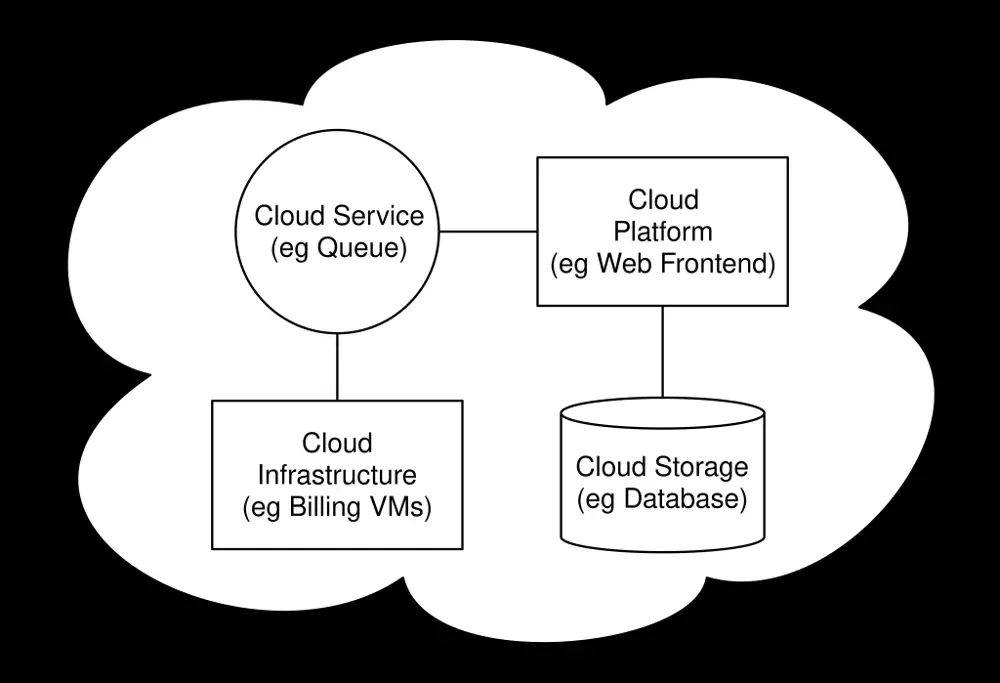
The diagram above illustrates a basic cloud architecture. The bottom layer is the cloud infrastructure – the pooled compute, storage and network resources. On top of it sit cloud platforms and services. When a user requests a virtual machine or database, the cloud management software allocates compute instances and storage from the underlying infrastructure. The provider’s high-speed networks connect servers across multiple data centers so that services can scale globally.
Cloud infrastructure can be deployed as public clouds, private clouds, or hybrid clouds. In a public cloud, a third-party provider runs the infrastructure and offers services over the Internet to multiple customers (multi-tenant). In a private cloud, a single organization owns and operates the infrastructure (often with virtualization software like OpenStack). Hybrid clouds connect the two models. In all cases, the underlying components (servers, networking, storage, virtualization) are largely the same – the difference is who owns and operates them.
What Are the Components of Cloud Infrastructure?
Cloud infrastructure is assembled from multiple key building blocks:
- Compute (Servers). Physical machines (CPUs, RAM) that run applications. Cloud providers group servers into clusters. Virtualization software partitions each server into virtual machines (VMs). These VMs act like independent servers, running user applications. Because providers have vast server farms, they can launch hundreds or thousands of VMs on demand.
- Persistent storage systems that hold users’ data. This includes distributed disk drives, SSD arrays, and object storage. Cloud storage is elastic: users can store and retrieve vast amounts of data while the provider automatically replicates it across disks and data centers. Examples include Amazon S3 and Azure Blob Storage.
- The routers, switches, and cabling that connect servers together and link to the Internet. Software-defined networking (SDN) allows programmatic control of traffic. Load balancers route incoming requests across servers for performance and fault tolerance. With high-speed links between regions, cloud services can operate globally.
- Virtualization and Software Layer. Hypervisors (like VMware ESXi or open-source KVM) and container platforms (like Docker/Kubernetes) create and manage the VMs or containers. Cloud management platforms provide dashboards and APIs for orchestrating resources. For example, OpenStack is an open-source platform consisting of software components to control and automate compute, storage and networking – it is “a set of software components that provide common services for cloud infrastructure”[8].
- Security and Management Tools. Identity services (user authentication), encryption, monitoring and logging are integral. Cloud infrastructure includes firewalls, IAM controls and automated security checks. For instance, many providers embed encryption, access control and threat monitoring to protect data[9]. On the operations side, automation tools handle tasks like OS patching, backups and scaling so that virtual servers are always up to date.
Each of these components must integrate smoothly so that users see cloud resources as a unified system. For example, when a virtual machine boots, it may need network and storage instantly; the cloud’s orchestration layer handles all this coordination.
What Are Cloud Infrastructure Service Models?
Cloud providers package their infrastructure into different service models:
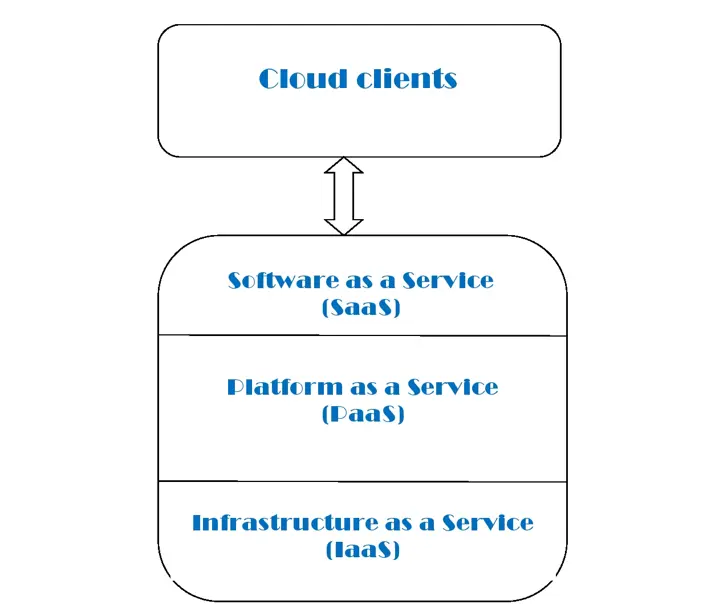
– Infrastructure as a Service (IaaS). The provider delivers raw servers, storage, and networking. The user installs and manages the OS, middleware and applications. IaaS offers maximum control – it’s like renting a plot of land where you can build anything you want[10]. Examples include AWS EC2, Google Compute Engine, and Azure Virtual Machines.
– Platform as a Service (PaaS). The provider supplies not only infrastructure but also a ready-to-use platform (runtime environments, databases, development tools). The user simply deploys application code. PaaS is like renting the tools and equipment to build a house instead of managing the construction site[11]. Examples include Google App Engine, Heroku, and Azure App Service.
– Software as a Service (SaaS). Fully managed applications delivered over the Internet. Users access the software via a browser or API and use it without managing any servers. It’s like renting a fully furnished house – the provider handles everything. Common SaaS examples are Gmail, Office 365, Salesforce and many more[12].
All these models rely on the same underlying cloud infrastructure. In IaaS, the customer configures almost the entire stack on the rented servers. With PaaS and SaaS, the provider manages more of the software layers. Newer models like Serverless/FaaS (functions-as-a-service) or containers abstract the servers further, but ultimately they still run on VMs or nodes in the cloud.
What Is Cloud Infrastructure Management?
Cloud infrastructure management refers to the tools and processes used to provision, monitor, and scale cloud resources. Instead of manually configuring hardware, teams now use automated tools. A common approach is Infrastructure as Code: tools like Terraform or AWS CloudFormation let you declare infrastructure in code, which the cloud service then provisions automatically. AWS notes that Terraform can “create, provision, and manage cloud IT resources” automatically[13], so you can focus on requirements instead of low-level setup.
Cloud management also includes monitoring and orchestration. Providers offer consoles (and APIs) for administrators to launch and configure resources. Performance metrics and logs track the health of VMs, storage and networks. Built-in features can automatically scale resources up or down based on load or restart failed instances. Security management is part of this: for example, cloud platforms provide identity and access control services and can apply security patches. In practice, developers rarely touch the hardware directly. Instead they might commit code and let pipelines provision any needed infrastructure automatically. As Spotify’s VP of Tech explains, having their infrastructure managed for them lets teams “concentrate on what’s important to our users”[4]. In summary, cloud infrastructure management makes the entire stack programmable and scalable.
Why Cloud Infrastructure Matters
Cloud infrastructure brings key benefits: scalability, cost efficiency, and agility. Organizations can quickly scale out resources during peak demand and scale back when no longer needed. They pay only for what they use, turning capital expenditures into operating expenses. Because providers run the infrastructure, businesses avoid maintaining large data centers and on-site IT staff. Cloud platforms also offer high availability: for example, they replicate data and instances across regions so outages in one location don’t cause downtime in others.
A recent Gartner report emphasizes how trends like artificial intelligence are accelerating cloud adoption[14]. In fact, many companies are embedding AI into cloud services for smarter operations. Future cloud infrastructure is expected to have built-in predictive tools – for example, auto-scaling based on AI-driven forecasts. This evolution means the cloud will continue to become more dynamic, adaptive, and resilient over time.
In short, robust cloud infrastructure allows organizations to innovate faster. Developers gain access to the latest tools (big data platforms, machine learning services, edge computing) without investing in specialized hardware. Global companies like Netflix and Spotify illustrate this: they leverage cloud-native analytics and content delivery at scale, which would be impractical on traditional infrastructure[3][4].
Conclusion
Cloud infrastructure is the unseen engine powering our digital world. It combines vast data centers, powerful hardware and sophisticated software to deliver computing on demand. In this article we saw that cloud infrastructure includes servers, storage, networking, virtualization layers and management tools[5][6]. We explored how it works (virtual machines, automation, global scale), the key service models (IaaS/PaaS/SaaS), and why businesses use it. By offloading infrastructure to cloud providers, organizations gain flexibility and scale, enabling innovation without large up-front investments.
FAQs
1. What is cloud infrastructure?
It’s the collective hardware and software resources (servers, storage, networking, virtualization, etc.) that support cloud computing. In other words, the data centers and systems that deliver cloud services[5].
2. How does cloud infrastructure work
Cloud infrastructure pools servers and storage across data centers. Virtualization software splits these into virtual machines or containers. When you request a service, orchestration tools automatically allocate compute, storage and network capacity to run it[7][15]. This automation makes resource provisioning fast and on-demand.
3. What are the components of cloud infrastructure?
The main components are compute (physical servers or VMs), storage (disk volumes and object stores), networking (routers, switches, virtual networks) and the virtualization/management layer that ties them together[5][6]. Security tools (firewalls, IAM) and administration consoles are also part of the stack.
4. What is cloud infrastructure management?
It refers to the tools and processes for controlling cloud resources – from provisioning and scaling to monitoring and security. For example, Infrastructure as Code tools like Terraform let admins declare their infrastructure in code, which the cloud platform then builds automatically[13]. Providers also offer dashboards and APIs to handle day-to-day operations.
5. What infrastructure is needed for cloud computing?
Cloud computing infrastructure requirements include reliable high-speed networks, powerful servers (CPUs, memory, GPUs/ASICs), scalable storage systems, and virtualization software. Public cloud providers supply all these by default, so end users simply need an internet connection and the right credentials to tap into the cloud platform.
Sources
[1] [2] [14] Gartner Forecasts Worldwide Public Cloud End-User Spending to Total $723 Billion in 2025
[3] Netflix Case Study
https://aws.amazon.com/solutions/case-studies/netflix-case-study/
[4] Google Cloud Announces Plans for First Cloud Region in Sweden to Drive Sustainable Business Transformation
[5] [9] [15] What is Cloud Infrastructure? | Microsoft Azure
https://azure.microsoft.com/en-us/resources/cloud-computing-dictionary/what-is-cloud-infrastructure
[6] What is Cloud Infrastructure? – Cloud Computing Infrastructure Explained – AWS
https://aws.amazon.com/what-is/cloud-infrastructure/
[7] [10] [11] [12] What is the cloud? | Cloud definition | Cloudflare
https://www.cloudflare.com/learning/cloud/what-is-the-cloud/
[8] Open Source Cloud Computing Infrastructure – OpenStack
[13] Terraform vs Kubernetes – Difference Between Infrastructure Tools – AWS
https://aws.amazon.com/compare/the-difference-between-terraform-and-kubernetes/
The Tech Junction is the ultimate hub for all things technology. Whether you’re a tech enthusiast or simply curious about the ever-evolving world of technology, this is your go-to portal.