
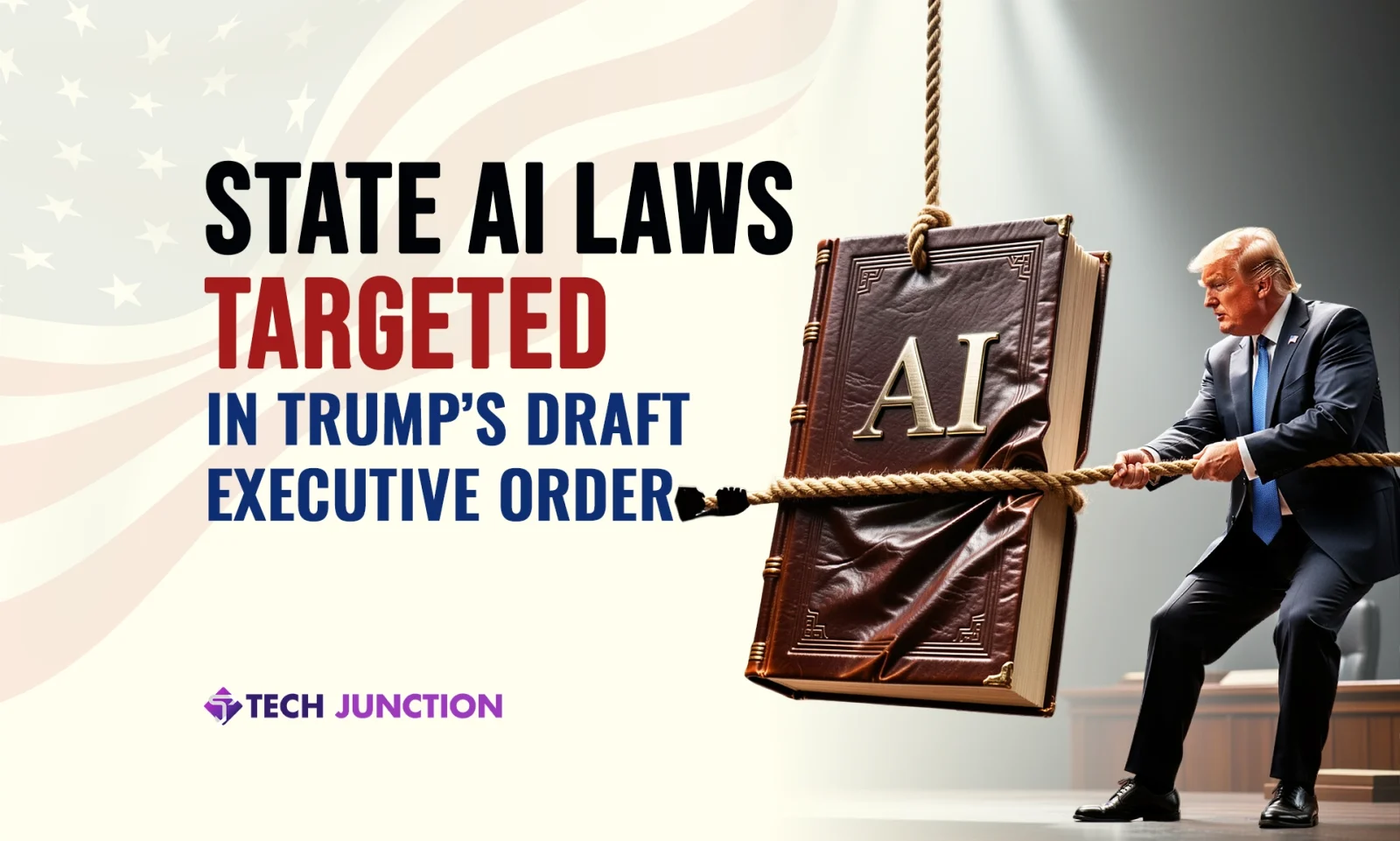
State AI laws across the United States have proliferated in recent years, creating a patchwork of rules for artificial intelligence. In AI regulation news of 2025, President Donald Trump’s administration is moving to override this patchwork with a single federal approach.
This bold Donald Trump AI initiative, which is described by Trump as establishing “ONE RULE” for AI, is making waves in US AI regulation news. The draft order aims to sustain America’s lead in AI innovation by avoiding what Trump calls burdensome “50 different approvals” across states.
However, the prospect of a White House executive order overriding state decisions has ignited debate over federalism, innovation, and public safety. Lawmakers, tech companies, and legal experts are grappling with a central question: Can a president’s executive order unify national policy without trampling state authority?
In other words, will one rule for AI help the nation or hurt it? This article dives into Trump’s draft AI order, the state laws it targets, the legal battles brewing, and what it all means for the future of AI governance in America.
1. Why Are States Passing Laws on AI?
Q: Why have so many states introduced laws on AI, and what do these laws do?
In the absence of comprehensive federal legislation, U.S. states have stepped in to regulate artificial intelligence on their own terms. In 2024 alone, lawmakers in 45 states introduced hundreds of AI-related bills, and dozens were enacted into law. These laws on AI vary widely in scope and purpose. For example:
- Some states address consumer protection and privacy, ensuring AI does not exploit personal data or mislead consumers.
- Others focus on preventing harms from AI-generated content, like deepfakes and disinformation, to protect elections or stop impersonation scams.
- A few states target bias and discrimination – requiring transparency and fairness in algorithms used for hiring, lending, or policing.
- Many state laws include transparency mandates, such as requiring AI-generated content to be labeled or forcing AI developers to disclose how their models work.
California recently passed a landmark AI transparency law that demands major AI developers publicly report their safety and risk measures. Colorado’s new AI Act prohibits certain discriminatory uses of AI and imposes reporting requirements to ensure fairness. Texas and Illinois have outlawed AI deepfake pornography and certain biometric abuses, respectively. And Tennessee created a right to one’s voice, making it illegal to clone someone’s voice with AI without consent.
2. What Is Trump’s Draft Executive Order on AI Proposing?

Q: What does President Trump’s draft executive order on AI seek to accomplish?
President Trump’s draft executive order – reportedly titled “Eliminating State Law Obstruction of National AI Policy” – lays out a broad federal strategy to rein in state-level AI regulation. The six-page draft does not create new rules for AI; instead, it directs federal agencies to take actions aimed at overriding or pressuring states. Key provisions in the draft order include:
- Department of Justice Task Force: Instructs the U.S. Attorney General to establish an “AI Litigation Task Force” to sue states over AI laws the administration deems unlawful. These lawsuits would claim that certain state laws unconstitutionally burden interstate commerce or are preempted by federal regulations. It also calls for the Commerce Department to list specific “burdensome” state AI laws that should be challenged (for example, laws compelling AI firms to make certain disclosures or to alter “truthful” model outputs).
- Withholding Federal Funds: Directs federal agencies to wield funding as a lever. In particular, the order threatens to cut off certain grants from the $42.5 billion Broadband Equity, Access and Deployment (BEAD) program to states with undesirable AI laws.
- Federal AI Standards: The order asks regulators to develop consistent national guidelines. It directs the FCC to consider a unified reporting/disclosure standard for AI models, and it tells the FTC to assert when its consumer protection powers should preempt state laws that force “truthful” AI outputs to be altered.
Notably, the draft does not set any new federal rules for AI development or use, as it’s focused on blocking state interventions rather than creating national regulations.
The goal, as the order’s preamble states, is to “sustain and enhance America’s global AI dominance through a minimally burdensome, uniform national policy framework”.
3. Which State AI Laws Are Being Targeted, and Why?
Q: What kinds of state AI laws are being targeted, and why?
The administration is zeroing in on state laws that require AI developers to disclose information or alter how AI systems work. For example, California’s new AI transparency law forces big AI model makers to publish their safety and risk policies.
Colorado’s AI Act similarly aims to curb algorithmic bias. Trump officials have blasted these as “burdensome” rules that could force changes to the “truthful outputs” of AI models in the name of DEI (diversity, equity, inclusion). In their view, such mandates hinder innovation and should be challenged or preempted.
States, meanwhile, defend these laws as sensible guardrails by addressing issues like AI-driven fraud, discrimination, and deepfakes that Washington hasn’t yet tackled. They argue local communities need protection if the federal government won’t act.
4. Can a Federal Order Override State AI Laws? (Legal & Political Challenges)
Q: Is it actually legal for a presidential executive order to nullify state AI laws, and how are people reacting?
An executive order cannot directly overturn state laws, only Congress (or the courts) can. So Trump’s draft takes an indirect approach: it leverages federal power to undermine state regulations. The order instructs federal agencies to challenge state laws in court and attach strings to federal funds, effectively pressuring states to fall in line.
Legal hurdles. Many experts predict the order will face immediate court challenges if signed. States are likely to sue, claiming the President is overstepping his authority and infringing on states’ rights.
Key legal issues include:
- Commerce Clause: DOJ might argue that certain state AI laws violate the U.S. Constitution’s Commerce Clause by placing an undue burden on interstate commerce. However, courts usually reject such claims unless a law clearly discriminates against out-of-state businesses. Since most state AI laws apply broadly (to any AI used in the state), this Commerce Clause attack is widely considered weak.
- Federal Funding Limits: Using federal grants as leverage faces legal limits. Courts could see it as “impermissibly coercive” to withhold unrelated funds (like broadband money) in order to pressure state policies. Courts have struck down similar attempts to impose unrelated conditions on federal funding. Likewise, if the administration tried to pull internet funds over a state’s AI law, that state would almost certainly challenge it as an abuse of spending power.
- Political blowback. Not everyone in Washington is on board. Some Republicans object to curbing state power: Rep. Marjorie Taylor Greene argued “states must retain the right” to make their own AI laws, and Sen.
Josh Hawley said it’s “crazy” to preempt states trying to protect kids from AI harms.
Democrats are likewise outraged – Sen. Amy Klobuchar blasted the draft order as “unlawful” and warned it attacks states for putting up AI guardrails.
Consumer advocates, too, call it unfathomable that the administration would block sensible state regulations while AI is already causing harm.
Industry reaction. Tech companies and investors largely applaud Trump’s push. They have long urged federal preemption of state rules, arguing a patchwork hinders innovation.
Venture firm Andreessen Horowitz, for example, warned that state-by-state AI laws place “clearly excessive” burdens on AI development. Organizations like NetChoice praised the promise of one national AI policy as a way to avoid compliance nightmares and secure American tech dominance.
In line with these views, the Trump administration’s AI strategy has prioritized minimal regulation – a July 2025 White House plan explicitly promoted “AI dominance” with few constraints. This draft executive order reflects that pro-industry philosophy.
What’s Next for AI Regulation in the US?
As of late 2025, Trump’s draft order remains unissued, and the fight over AI governance now shifts to the courts and Congress. This high-profile clash in US AI policy news today could spur federal lawmakers to act—perhaps finally passing a national AI law—but until then, states will keep pushing their own measures (some may hold off under the threat of lost funds).
In short, US state AI laws remain defined by flux – uncertainty persists over who will set the rules. The next year will be critical in determining whether one federal rulebook or continued state innovation will shape America’s AI policy.
FAQ: State AI Laws and Trump’s Order
Q1: What are “state AI laws,” and why do they matter?
They’re laws passed by individual U.S. states to regulate artificial intelligence. These rules tackle issues like privacy, discrimination, deepfakes, and transparency. They fill gaps where federal law hasn’t caught up, but could be overridden by national policy.
Q2: What exactly would Trump’s AI executive order do to state laws?
It directs federal agencies to sue states with “burdensome” AI laws and threatens to cut off funding, like broadband grants. The goal is to pressure states into aligning with a lighter, unified federal approach. It doesn’t void state laws outright but sets legal and financial traps to make them harder to enforce.
Q3: Is it legal for a President to override state laws like this?
Not directly. Executive orders can’t erase state laws, but they can trigger lawsuits or withhold federal funds. Courts will likely decide if this crosses constitutional lines, and experts expect serious legal pushback.
Q4: Why are tech companies supporting Trump’s effort to preempt state AI laws?
They want one national rule instead of 50 conflicting ones. Companies argue state patchworks make compliance costly and innovation slower. A single standard feels more predictable and business-friendly to them.
Q5: What might a national AI law look like, and would it address the same issues as state laws?
A federal AI law could set minimum standards for safety, fairness, and transparency. It might replace or limit state laws, depending on how it’s written. Whether it protects citizens as strongly as current state laws remains to be seen.
The Tech Junction is the ultimate hub for all things technology. Whether you’re a tech enthusiast or simply curious about the ever-evolving world of technology, this is your go-to portal.